
INTERVIEW WITH christopher evans
Christopher Evans is a self-taught painter living in Kielder Forest, a place that has had a profound effect on his self-expression. He has a mental condition called aphantasia, which means he has no access to inner senses, including visualisation, and he is also on the autism spectrum, which he is now learning to integrate into his practice through keeping his process alive, mindfulness, and playfulness. Painting is a necessity for him—his lifeblood, a joy, and a way of making sense of and communicating with the world.
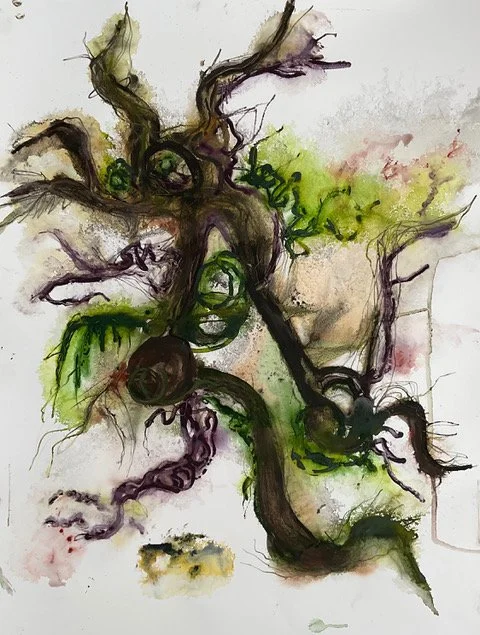
‘‘Painting is a language that is beyond words…’’
As a self-taught painter living in Kielder Forest, how has this environment shaped your artistic practice since your move in 2025?
Kielder opened a door to how I experience nature , I began a weekly nature and mindfulness blog diary in which I wander Kielder with my camera and this opened a door of how I experience nature, its textures, shapes, forms, light, continuous changes, moods, and colours. Mindfulness and my spiritual path had enhanced my experience of nature along with sitting in silence , taking photographs and painting. Living in the Forest had allowed easy access and seeing it from my window everyday reminds me of the space I have come to love.
You began your artistic journey in 2017 following a traumatic experience. How has painting supported your healing and personal transformation since then?
Painting is a language that is beyond words and what comes from me makes perfect sense without needing to explain it in words. I feel connected to everything when I paint and I let go of thinking by just being present putting paint onto paper. The process regulates my emotions as I can just be simply painting without need for it to be anything more than that. It does not take me from reality but is reality.
Living with aphantasia, how does the absence of visual imagination influence the way you approach painting and composition?
Painting is a physical process in which I have to still my mind , connect to my body and allow it to paint ; allowing what comes out automatically from a sense of knowing, instinct and intuition. I have worked hard on non attachment to outcome, feeling an imposter and trusting myself to what unfolds during my painting process is what my soul wanted to create. Nothing is right or wrong but just is. I do still struggle everyday with negative thoughts but I have learnt from my mindfulness training to let them be.
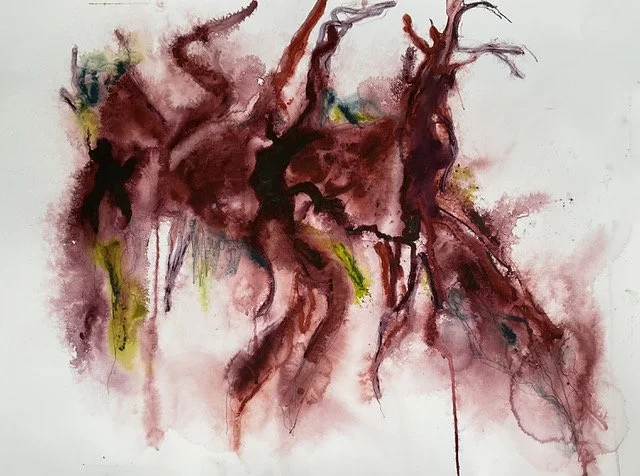
How did the use of small watercolour paintings initially emerge as a tool for regulating your mental health, and how has this practice evolved over time?
I had a 6 month break after my Dad died and then I had to move from my rented cottage into my Dads empty house with just a chair , table and bed for 2 months before I moved into my forever home in Kielder. As things were strained and challenging with family I needed painting to help my mental resilience. I did not have the space so small watercolours , which I called ‘watercolour poem ” were easy to manage and allow me to paint each day. I have paintings when I was 5 and then in the same space 55 years later gave me sense of a full cycle and a sign of a new beginning. Curiosity and play evolved my work as I was creating one or two pieces in a day I wanted to explore and discover what the paint could achieve.
What drew you specifically to watercolour as your primary medium in relation to yourneurodivergence and way of perceiving the world?
It was making the watercolour poems which I was loving so much initially informed my medium choice. I felt connected to it , it felt similar to me unable to fit
properly into a system , it felt raw and energetic and that there were endless possibilities to how the material works and reacts with other materials. I love the idea of a medium which is often related to precision and perfectionism into something quite wild.
How did your diagnosis of autism further inform or clarify your artistic process and material choices?
I have a need to be free of orthodoxy and fitting in as my condition has caused friction in my life trying to fit. Now I want to learn about it , align my life to it and utilise it. I can pour raw intention of energy into water resting on paper and intuitively play with it without any plans and see what happens. That is pure joy : It is a happening , dance , right in the moment and exciting. My Autism doesn’t want to be perfect , follow rules and conditions , be like others , have a plan or even be liked.
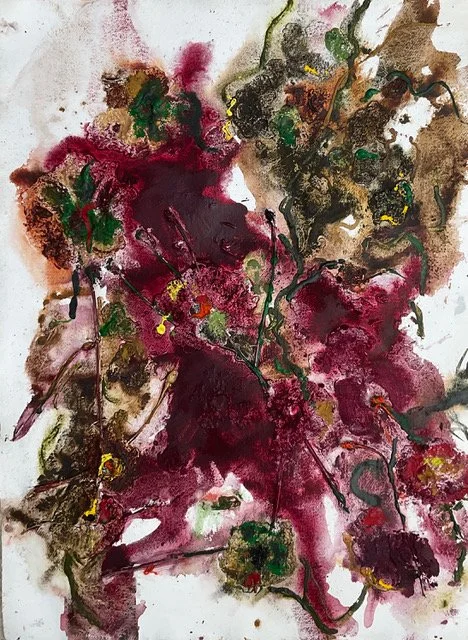
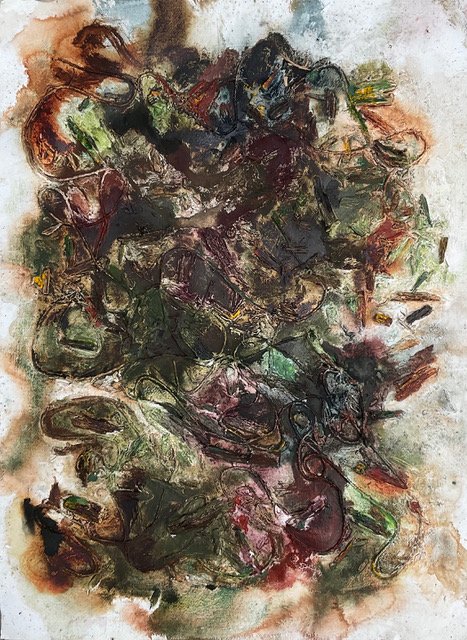
When you describe watercolour as “immediate, mutable, un-editable and ethereal,” how does this align with your creative intention?
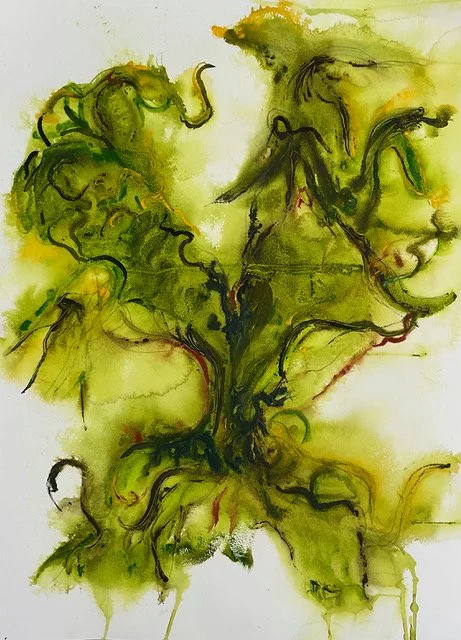
The forest is not static , even the things which appear still have movement. Even that which seems dead is just alive differently. It is impermanent , raw and right in the now. Watercolour captures these qualities in which I can place my intention with colour and movement then let the magic happen without needing to control it. The medium helps me be the forest.
Your time in Kielder Forest appears to have been a turning point. How did the landscape influence the emotional and spiritual direction of your work?
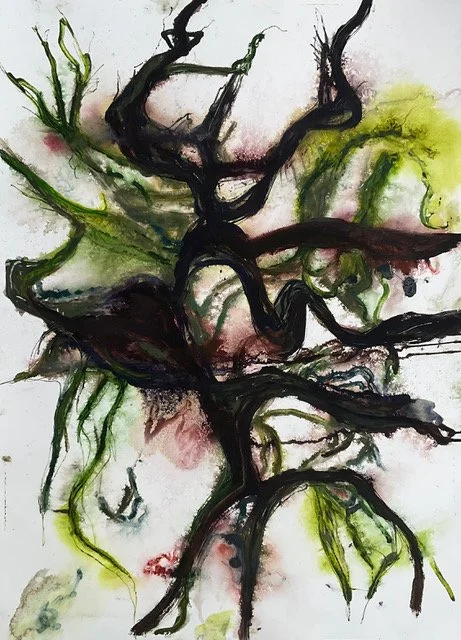
I spent a lot of time wandering and just sitting in the forests depths and I began to feel something awaken inside of me which I was curious about and wanted to recreate this in my studio communicate something which captures its spirit. To help people perceive and experience the forest differently. As I wandered I saw up-turned trees from storms which nature had transformed with moss along with other organisms also root systems were now defying gravity
which had a mystical presence. I was curious about the language of this , the moss shapes looked like Zen calligraphy and the roots forms like magical beings
with a story to tell. This felt like my world , it was un-seen , not relevant, weird and not cared about. I realised that I belonged no matter what in the forest and nothing is broken , just different and nothing dies , just transforms. This aligned to my work with mindfulness and buddhism. The forest became my meditation master , my muse and friend.
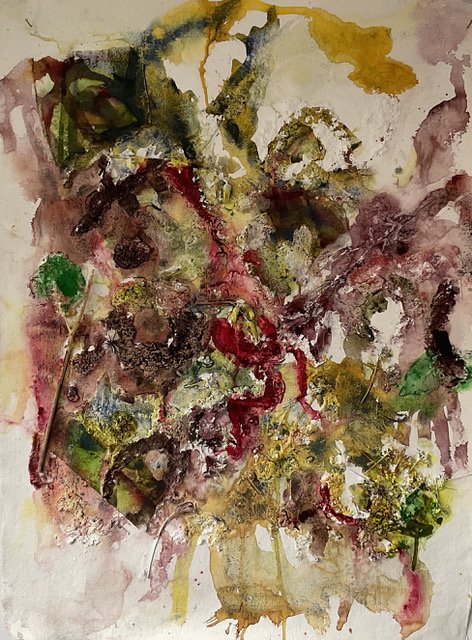
Given that you do not have autobiographical visual memory, how does this affect your relationship to place, memory, and artistic documentation?
A good phrase of Aphantasia is “ out of sight , out of mind “ . I have no definable known past. It is heart breaking that I cannot hold onto a person , a place, an event or what I do and simply lose connection. However , the absence of inner senses creates a deep presence and awareness which is magical when I tap
into it. I am always trying to find and keep a connection to something. I have various strategies with art documentation and building ideas. I use sketchbook to play , discover and also to hold a visual memory. One book I play with paint, combinations of colours and qualities of paint with different quantities of water or when or how I place the water. Another is going out and just being free with the forms I find and see what happens. The actions holds within my body if I keep doing it. There always has to be love involved in what I paint. I journal my Embodied Nature and Plein Air Pieces, colours and techniques I have used
You describe seeking memories through the body rather than the mind — how does this somatic approach manifest during the act of painting?
Through my mindfulness practice and training of 6 years I have learnt to be within my body more than my thinking mind: it has developed a sense of knowing which I cannot explain in words , it just is. I wish I had the words to describe the seeking of a memory of a feeling that I experience in the forest but I think it is easier explained as I am trying to create something which holds the spirit of the forest via a hidden force within me. My wish is for people to experience a deeper spiritual resonance of the forest and how we can connect to it through our feelings within our bodies which is the language of nature.
Discover more:
